
Every lead captured, scored, and proven
Stop wondering what happened to incoming leads. We organize every phone call, form fill, chat, and text into a filterable timeline so you can track performance and close more jobs.
Roofing replacement requests dominate high-intent leads this month, and organic search is producing your highest-scoring conversations.
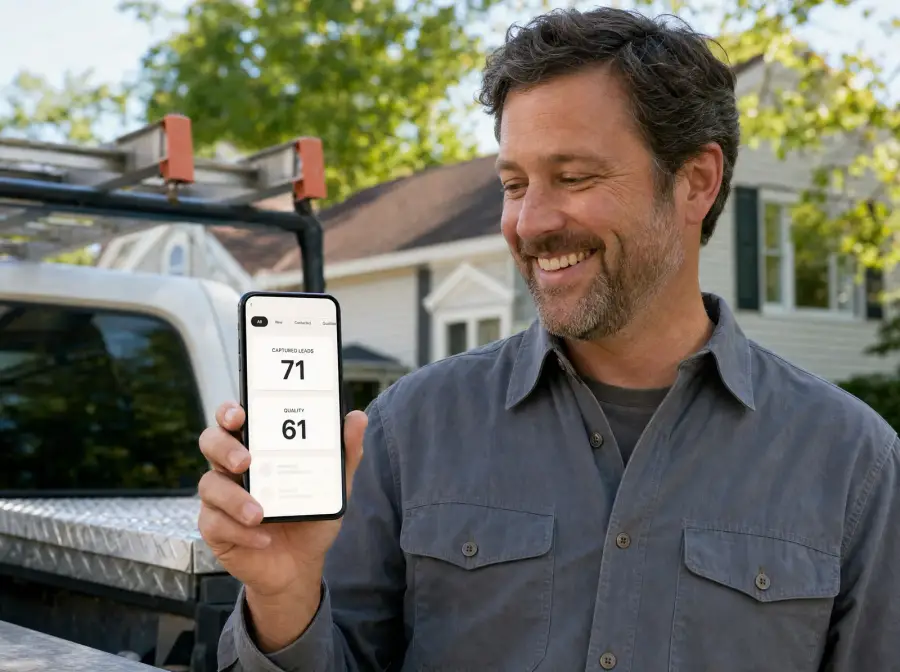
Track every lead, every time
Most agencies count leads and call it a report. 50 form fills look great until you find out how many were spam, wrong numbers, or window-shoppers. We don't play that game. Our leadIQ platform pulls every call, form, chat, and text into one chart, grades each one for real buying intent on a 1-to-5 scale, and shows you the exact campaign that earned it. No more cheering for a number . . . just working the leads that turn into booked jobs!
This is the actual screen
Roofing replacement requests dominate high-intent leads this month, and organic search is producing your highest-scoring conversations. Five of 71 leads were operational noise and filtered from your cost per lead.
From guesswork to a decision you can defend
- Fifty leads a month and no idea which ones were real
- Calls go unlogged and form fills sit in an inbox
- Spam, wrong numbers and B2B solicitations all count toward cost per lead
- Your marketing looks worse than it is, and the team burns the day on dead ends
- Every call, form, chat and text in one inbox, timestamped
- Filterable by channel and by date
- AI grades each conversation 1–5 on real buying intent
- Full last-click attribution — paid, organic, Google Business Profile or an AI engine
- Your team spends the day on leads that can become jobs
- Cost per lead reflects real opportunities, not robocalls
- You can see which service is actually in demand
- And which source produces your best customers, with the names to prove it
The AI does two jobs here. Per lead, it reads the actual conversation — what was asked, how specific it was, whether contact details are real — and grades intent, then writes a short summary so you do not have to listen to a four-minute call. Across all leads, it tells you what is being asked for most, which channel produces the highest-scoring conversations, and what changed since last month.
What leadIQ reports, and how to read it
Every number on the screen, what it actually measures, how to interpret it, and why it matters to your business.
01 Total leads Every captured contact in the range, across all four channels.
Read it as a raw count, not a scoreboard. If it says 35, that is 35 contacts that came in — not 35 jobs worth chasing. The AI Quality Score below is what tells you how many were real.
The total on its own can flatter a bad month or hide a good one. Thirty-five leads with twenty scored 3-or-better is a strong month; the same thirty-five with five is a spam problem. Act on the quality number, not the total.
02 AI Quality Score (1–5) Each lead graded on real buying intent, from elite (verified info, high-value project) down to operational noise (wrong numbers, spam).
Watch the count of 3-and-above, not the average. That is your real lead count.
Turns "we got 50 leads" into "we got 22 real jobs" — the single most important reframe in the whole product.
03 Leads scored 3+ Genuine inquiries with real intent, excluding low-intent and noise.
This is the number to hold marketing accountable to and to divide spend by.
It is the honest denominator for cost per lead. Everything else flatters the numbers.
04 Source attribution (UTM) Last-click source for every lead: paid search, organic, GBP, referral or AI engine.
Cross-reference source against score. Cheap sources that only produce 1- and 2-star leads are not cheap.
Shows where to put the next dollar, judged on lead quality rather than lead count.
05 Worked / unworked + lead value Your team's own CRM markers: whether a lead was followed up, and what it was worth.
Unworked 5-star leads are the most expensive thing on this screen. Zero is the target.
Closes the loop between marketing and the sales floor, and feeds real revenue back into campaign ROI.
Set the score filter to 3+ and the range to last 30 days. That view is your actual pipeline. Then flip through channels to see which ones are producing it, and check the unworked column before you do anything else.
Built for how contractors actually work
- Separate views by channel: email, chat, phone call and SMS
- AI Quality Score, 1–5 stars, on real buying intent
- Full last-click UTM attribution — paid, organic, GBP or AI engine referral
- Read an AI summary of any lead, or the full email and transcript
- Mini CRM: mark leads worked or unworked and record lead value
AI reads every conversation and grades it on real buying intent, then explains which services are in demand and which sources produce your best leads — turning "we got 50 leads" into "we got 22 real jobs."
Nothing slips through the cracks, and spam never inflates your cost per lead. You see what people are actually asking for and where your best work comes from.
Five levels of buying intent
Every lead is graded on what it actually is — so your team spends its day on the ones that can become jobs.
How leadIQ turns fifty raw leads into your actual job count
Most agencies hand you a lead count and call it a win. But a "lead" can be a bot filling out a form, a wrong number, a job seeker, or a vendor pitching you software — and every one of those drags down your numbers and burns your team's morning. leadIQ reads what actually happened in each conversation, scores it on real buying intent, and shows you the handful that can become jobs.
Every call, form, chat and text in one inbox
leadIQ captures every inbound lead across all four channels — phone calls, form fills, web chat and SMS — timestamped, filterable by channel and date range, with the actual content of each conversation sitting right there. Instead of a call log in one place, form emails in another and chat transcripts nowhere, it's one inbox. And it isn't just storing them: the AI reads each conversation and writes a short summary, so you know what a four-minute call was about without listening to it.
Why a 1–5 score beats a raw lead count
A raw conversion count treats a verified roof-replacement request and a robocall as the same thing. They are not. leadIQ grades every lead 1 to 5 on how much real buying intent the conversation shows — a five is a named prospect with real contact details asking for a quote on a high-value job; a one is a wrong number or gibberish. The tiers in between exist because early-research inquiries and out-of-scope solicitations are real categories your team handles differently. That's the whole reframe: "we got fifty leads" becomes "we got twenty-two real jobs" — the honest number to run the business on.
Spam filtered, so cost per lead tells the truth
Here's where the score pays for itself. When the 1- and 2-star noise — robocalls, wrong numbers, B2B solicitations — is filtered out of the math, your cost per lead is measured against genuine opportunities only. An agency claiming fifty leads off a campaign looks very different once forty of them turn out to be junk. leadIQ gives you the real denominator, so you can hold a campaign accountable to the jobs it can actually produce instead of the activity it generated.
Last-click attribution back to the exact source
Every lead carries full last-click UTM attribution, so you see exactly what sent it — paid search, organic, your Google Business Profile, or an AI engine like ChatGPT or Gemini. The point isn't a prettier chart; it's that you can cross-reference source against score. A cheap channel that only produces 1- and 2-star leads is not cheap, and a source sending five-star jobs earns the next dollar. You put budget where the quality is, with the names to prove it.
One login, connected engines
Built for your trade
From roofing to HVAC to remodeling — 35+ home service trades, plus small business and automotive.
Trusted to grow home service companies since 2011
For over a decade, home service companies have trusted Triton to bring in more booked jobs — pairing marketers who know the trades with AI that works every lead around the clock.
This company truly helped us grow! Amazing people to work with. Wished I found them sooner!!!
Meet the team


















Questions about leadIQ
What home service owners ask us most about leadIQ.
How does leadIQ score a lead?
AI reads the actual conversation — what was asked, how specific it was, whether the contact details are real — and grades it 1 to 5 on real buying intent. A 5 is a verified, high-value project request; a 1 is a wrong number or bot spam. Every call, form, chat and text gets a score the moment it lands.
Does it work across calls, forms, chat and text?
Yes. Every channel lands in one inbox — phone calls, form fills, web chat and SMS — timestamped, filterable, and scored the same way. Tracked calls and SMS come in with call tracking; chat comes in with AI or live chat.
Will spam and wrong numbers stop inflating my cost per lead?
That's the point. Robocalls, wrong numbers, B2B solicitations and gibberish get graded 1 and filtered out of your cost per lead, so your numbers reflect real opportunities instead of noise — and your team stops burning the day on dead ends.
Can I tell which source produced my best leads?
Every lead carries full last-click UTM attribution — paid, organic, Google Business Profile, even AI engines like ChatGPT or Gemini — so you can see which channel produces your highest-scoring conversations, with the names to prove it.
Does the score reach my CRM?
Yes. The 1–5 score syncs into your CRM alongside the lead, so your team works the five-star jobs first without logging into anything else. Lead Sync handles pushing every scored lead into your system.
See leadIQ with your own numbers in it
Get a custom marketing plan and a walkthrough of the dashboard — no upfront design fees, no obligation.